
The Role of History
Every so often, someone will ask a question that sounds simple until you stop to think about what the words actually mean. One such question is, “What is the role of history in this?” The phrase appears in political theory, theology, constitutional interpretation, cultural analysis, family studies, literature, and almost any other field where the present moment is treated as the result of something that came before it.
At first glance, the wording can seem strange.
“Role” sounds active. It suggests an agent, a participant, perhaps even a character.
We speak of the role of Hamlet in Shakespeare’s play, or the role of a father in a household, or the role of a judge in a courtroom.
These are persons, or at least offices occupied by persons. They act. They deliberate. They respond. They make choices.
History, by contrast, seems static.
The past has already happened.
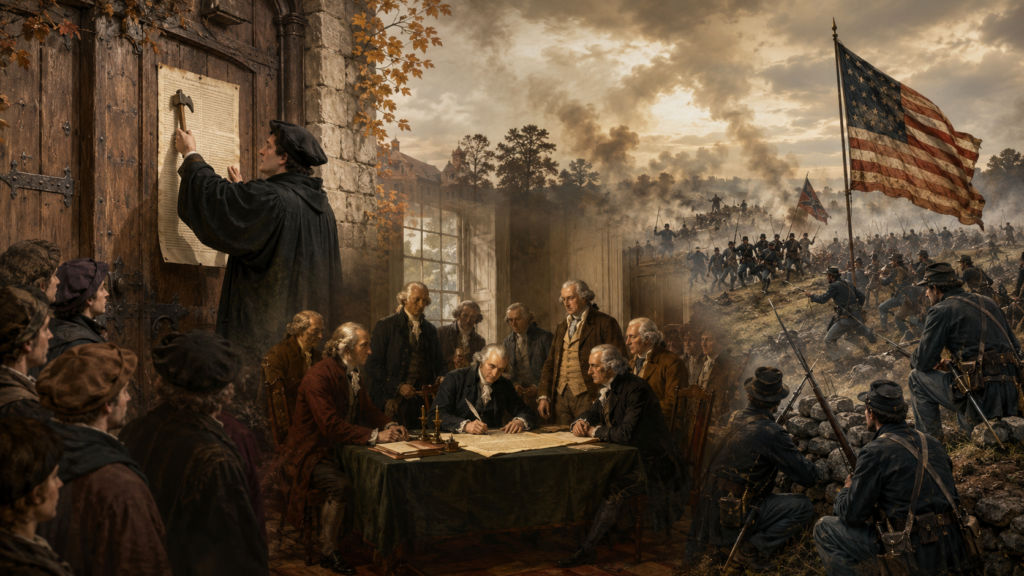
The generals at the Battle of Gettysburg are not actively making decisions.
Martin Luther is not waiting for his cue to nail his 96th thesis to the church door in Wittenberg.
The U.S. Constitution is signed, sealed, delivered, and actively dictating the daily lives of Americans through its execution and interpretation by the government.
Events have occurred, decisions have been made.
People lived and died. Institutions rose and fell.
In that sense, history is fixed. It is not alive in the way a character is alive within a story.
And yet, when we ask about the “role of history,” we are not suggesting that history possesses personal agency.
We are asking how the past matters.
That is the key.
The phrase does not mean, “What action is history taking?”
It means, “How does what came before help us understand what is happening now?”
The past may be over, but it is not irrelevant. It leaves behind institutions, assumptions, wounds, habits, loyalties, fears, precedents, obligations, and inherited stories.
These do not act independently of human beings, but they do shape the world in which human beings act.
History provides context
No society, institution, conflict, or person can be understood in isolation from what preceded it.
A political debate that seems irrational in the moment may make more sense when placed against the background of old betrayals, prior injustices, regional loyalties, or constitutional compromises.
A religious controversy may appear needlessly technical until one sees the centuries of doctrinal struggle behind a single phrase.
A family conflict may look like a disagreement about the present, when in reality it is entangled with memories, resentments, and expectations formed long before the immediate dispute began.
This is why history is often necessary for interpretation.
The present does not arrive as a clean sheet of paper.
It arrives marked up. It contains footnotes. It carries assumptions that are rarely announced openly.
To ask about the role of history is often to ask what must be known before the present can be understood honestly.
History matters as inheritance
We do not choose the world into which we are born.
We inherit languages, borders, institutions, religions, customs, economic systems, legal frameworks, and social expectations.
Some of these inheritances are blessings. Others are burdens. Most are mixed.
A constitution, for example, is not a document sitting in an archive collecting dust. It is a structure of authority that continues to organize political life.
A war does not end merely because the shooting stops. Its consequences may linger in borders, alliances, memories, debts, demographic changes, and national self-understanding.
In this sense, history functions less like a character and more like terrain.
It does not decide where we walk, but it does determine whether we are walking uphill, downhill, through open country, or across a field full of buried mines.
Human beings still choose.
Leaders still govern.
Citizens still deliberate.
Families still reconcile or refuse to reconcile.
But choices are made within conditions that previous generations helped create.
History operates through collective memory
This may be where the language of “role” becomes most tempting, because memory gives the past a kind of presence.
A nation, church, community, or family does not merely possess a past.
It tells stories about that past.
It remembers founders, heroes, martyrs, enemies, exiles, victories, humiliations, and betrayals.
Those memories shape identity.
They tell people who they are, what they owe, what they should fear, what they should preserve, and what they should resist.
Memory is not the same thing as history
Memory selects, emphasizes, forgets, distorts, sanctifies, and condemns.
But collective memory is one of the main ways history influences the present. People are moved not only by what happened, but by what they believe happened and what they have been taught that it means.
A battle may become a symbol of sacrifice. A defeat may become a grievance. A founding document may become a sacred text in civic life. A revolution may become a warning or a promise, depending on who is telling the story.
History constrains the present
This does not mean it removes freedom, but it does mean the past narrows or widens the field of plausible action.
A country with a long experience of tyranny may distrust concentrated power.
A people who have suffered conquest may be deeply protective of sovereignty.
A religious tradition shaped by heresy and schism may be careful, even severe, about doctrinal precision.
A legal system rooted in precedent may resist sudden innovation, not because innovation is inherently wrong, but because continuity itself is understood as a form of wisdom.
The past creates grooves.
Once a society has traveled in certain directions for long enough, those paths become easier to follow and harder to abandon.
Customs become normal.
Institutions defend themselves.
Language carries assumptions.
Even rebellion often defines itself against what came before.
The revolutionary may despise the past, but he is still responding to it.
History provides precedent
In law, politics, theology, and ethics, people often look backward to determine what should be done now.
Has this question been faced before? How was it answered? Did that answer produce order or chaos? Is there a tradition of interpretation that should guide us? Are there old errors we are in danger of repeating?
Precedent can be used wisely or foolishly.
The fact that something is old does not make it true.
The fact that something is traditional does not make it just. But neither does age make a thing disposable.
Historical precedent forces us to enter into conversation with those who came before us.
It reminds us that our moment is not the only moment; our anxieties are not the only anxieties; our insights are not the first insights ever granted to mankind.
So perhaps the better question…
is not whether history has a role, but what kind of role we are assigning to it.
History can explain, but not necessarily justify.
History can warn, but will we heed its warning?
History can shape identity, but not destiny.
Some people use history as an excuse
They speak as though the past makes present responsibility impossible.
Others use history as a weapon, selecting only a few fragments of the past which support their preferred narrative.
Still others ignore history altogether, imagining that every generation begins the world anew.
All three approaches are flawed.
The past should neither rule us absolutely nor be dismissed casually. It should be received, examined, judged, and understood. We are not slaves to history, but we are fools if we pretend we stand outside it.
This is where the analogy to a novel can be useful, provided we use it carefully.
History is not a character in the story. It does not walk onstage, deliver speeches, and make choices on behalf of the living. But it is something like the backstory, the setting, the inherited conflict, and the accumulated consequence that make the present action intelligible.
Characters in a novel may be free, but they are not floating in empty space. They have parents, homes, languages, wounds, loyalties, fears, and memories.
Their choices matter precisely because they are made within a world already charged with meaning.
So it is with us.
History is static in the sense that the past cannot be changed. But it is dynamic in the sense that its meaning, memory, and consequences continue to shape the living.
The dead do not govern by themselves.
The past does not act apart from us.
But we act within what the past has left behind.
To ask about the role of history, then, is simply to ask:
In what way does the past matter here?
Does it explain the present? Does it reveal a pattern? Does it expose an inherited wound? Does it supply wisdom? Does it warn us against arrogance? Does it remind us that we are not the first people to face confusion, conflict, ambition, temptation, fear, or hope?
Those are serious questions. And they are worth asking, not because history is a character in the novel, but because no one understands the plot by reading only the last page.
**This post was created with the assistance of AI.